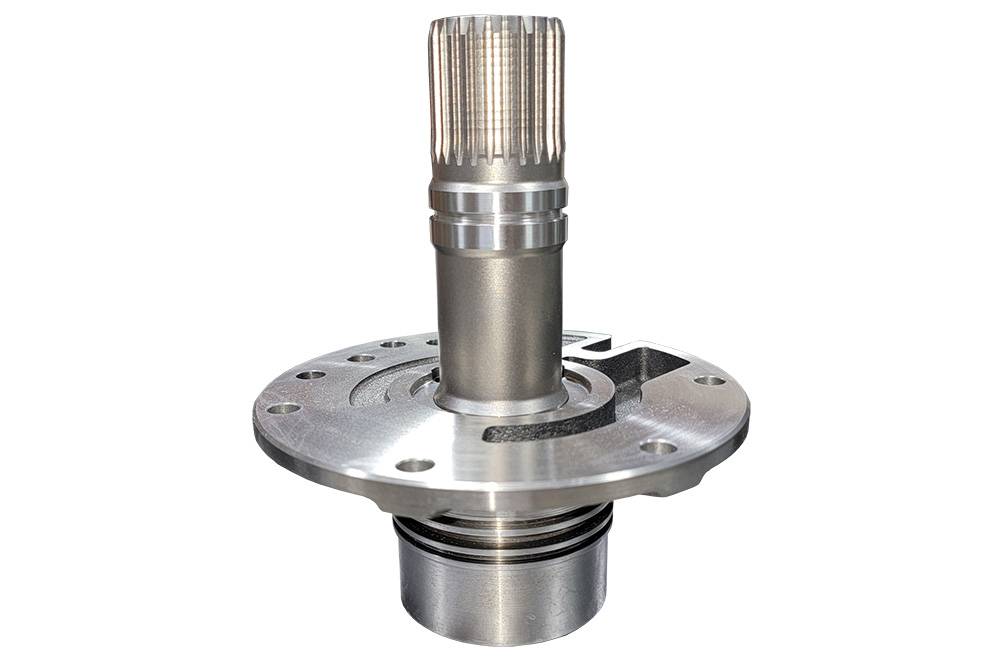
Stator Support Assembly
Chrysler 48RE
D100-G-48RE-SS
Pricing:
$210.00
FAQ
How does stator support alignment affect converter lockup?
Converter lockup issues are often traced back to obvious problems such as worn clutches, but small changes inside the pump assembly can have a direct impact on oil flow, and ultimately whether the converter clutch ever applies.
One key component in this system is the stator support. Its position within the transmission isn’t just structural. It directly affects the alignment between sealing surfaces and the oil feed passages that supply the converter. When everything is in its correct location, fluid routes cleanly through the input shaft seals and into the converter, allowing the clutch to apply as intended.
If the stator support is machined or otherwise repositioned, even slightly, it can shift the relationship between the seals and the oil feed holes. This doesn’t necessarily show up as a hard failure during assembly. In many cases, the only immediate sign is the need to adjust thrust clearances, often by installing thicker washers to bring everything back into spec. While that may restore endplay, it doesn’t correct the underlying alignment issue.
The result can be a misalignment where the sealing surfaces no longer properly register with the oil passages. When that happens, converter feed oil can be restricted or blocked entirely. Without sufficient oil flow, the converter clutch won’t receive the hydraulic pressure it needs to engage, leading to a no-lockup condition even though the rest of the system appears functional.
If clearances are significantly off from what would be considered normal, it’s worth verifying that all components, especially the stator support, are dimensionally correct and properly positioned. Using thicker washers to compensate may hide a deeper issue rather than solve it.
As power levels increase and transmission builds become more demanding, the margin for error shrinks. Proper oil circuit alignment becomes even more critical, and small deviations in component alignment can have outsized effects. Maintaining correct dimensions and verifying seal-to-passage alignment during assembly are essential steps in ensuring consistent converter lockup and overall transmission performance.
Does this stator support come with the rear bushing?
Yes, our stator support comes with the rear bushing preinstalled.
Converter lockup issues are often traced back to obvious problems such as worn clutches, but small changes inside the pump assembly can have a direct impact on oil flow, and ultimately whether the converter clutch ever applies.
One key component in this system is the stator support. Its position within the transmission isn’t just structural. It directly affects the alignment between sealing surfaces and the oil feed passages that supply the converter. When everything is in its correct location, fluid routes cleanly through the input shaft seals and into the converter, allowing the clutch to apply as intended.
If the stator support is machined or otherwise repositioned, even slightly, it can shift the relationship between the seals and the oil feed holes. This doesn’t necessarily show up as a hard failure during assembly. In many cases, the only immediate sign is the need to adjust thrust clearances, often by installing thicker washers to bring everything back into spec. While that may restore endplay, it doesn’t correct the underlying alignment issue.
The result can be a misalignment where the sealing surfaces no longer properly register with the oil passages. When that happens, converter feed oil can be restricted or blocked entirely. Without sufficient oil flow, the converter clutch won’t receive the hydraulic pressure it needs to engage, leading to a no-lockup condition even though the rest of the system appears functional.
If clearances are significantly off from what would be considered normal, it’s worth verifying that all components, especially the stator support, are dimensionally correct and properly positioned. Using thicker washers to compensate may hide a deeper issue rather than solve it.
As power levels increase and transmission builds become more demanding, the margin for error shrinks. Proper oil circuit alignment becomes even more critical, and small deviations in component alignment can have outsized effects. Maintaining correct dimensions and verifying seal-to-passage alignment during assembly are essential steps in ensuring consistent converter lockup and overall transmission performance.
Does this stator support come with the rear bushing?
Yes, our stator support comes with the rear bushing preinstalled.
Details
- D100-G-48RE-SS
- D100-G-48RE-SS
- Goerend
- New
Categories
Shipping Information
- Item Requires Shipping
- 15.0 lbs.
- W10.0000” x H10.0000” x L10.0000”